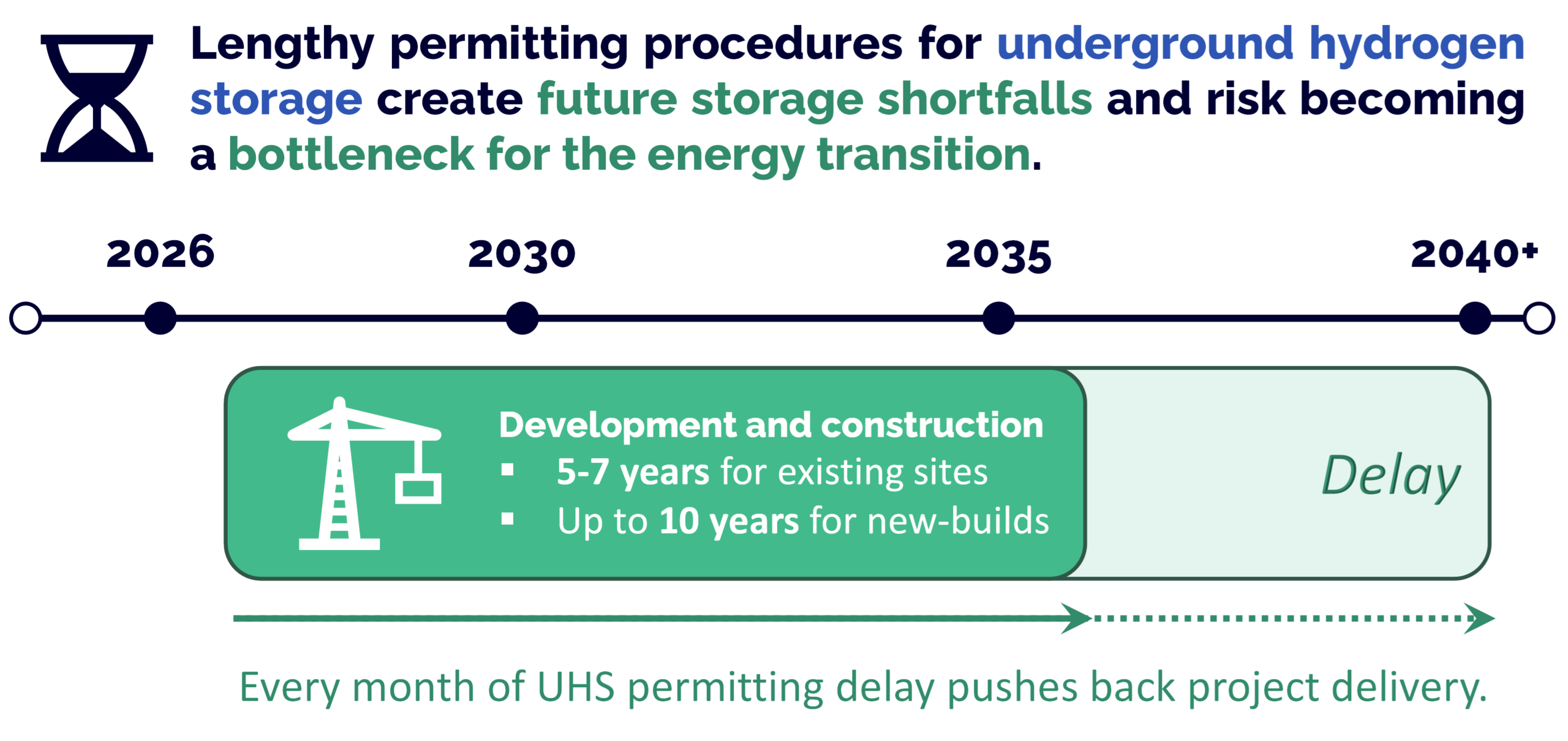
Permitting and regulatory approval for underground hydrogen storage (UHS) projects remain challenging in Europe. Regulatory uncertainty and the absence of dedicated frameworks can significantly delay project development, risking a bottleneck in the timely deployment of hydrogen infrastructure required for the energy transition. The European Union cannot envisage an integrated energy system without giving all required stakeholders along the value chains administrative urgency.
As negotiations on the amendments suggested by the Commission’s Grids Package continue, H2eart for Europe would welcome mandates around:
- including qualifying UHS projects within a dedicated, time-bound accelerated permitting procedure covering all relevant administrative and environmental decisions, with justified stop-the-clock mechanisms;
- extending the presumption of overriding public interest to hydrogen-system infrastructure that contributes to decarbonisation, security of supply or system flexibility;
- strengthen the permitting framework, by embedding a coherent legal basis or umbrella permitting regime for qualifying UHS projects, with clear coordination across relevant permitting processes and responsibility for the overall permitting timetable.
Why are the current proposals not sufficient?
The European Commission’s Grids Package marks an important step towards faster and more coordinated permitting for renewables, transmission infrastructure and energy storage. It rightly recognises that slow permitting is holding back the infrastructure that Europe needs for its decarbonisation objectives, competitiveness and security of supply. But its conclusions do not stretch equally across all relevant sectors.
For the energy transition to develop at pace, the infrastructure supporting it must be ready when we need it. That means building today – not at some point in the future, when the shortfall is noticeable. This is particularly important for UHS projects, which form a crucial link for the ramp up of both production and off-take assets as well as other H2 infrastructure. The typical lead times of 5-7 years for existing sites and up to 10 years for new-build assets, make early investment essential to ensure capacity is available when it is needed.
Yet, the proposal to accelerate permit granting procedures establishes a dedicated, time-bound procedure for stand-alone energy storage, but explicitly limits it to storage “other than hydrogen storage”.
More general provisions for hydrogen infrastructure permitting in the Grids Package are welcome improvements, but they do not provide UHS projects with a dedicated, predictable and accelerated permitting pathway.
Underground hydrogen storage may require different, more tailored procedures than other energy storage technologies due to its geological, environmental and safety characteristics. But those differences are a reason to design a fit-for-purpose framework – not to exclude strategically important UHS projects from an equally accelerated permitting scheme altogether.
Considering the lead times of repurposing or building new H2 Storage assets, lengthy and complex permission procedures delay FIDs for H2 Storage projects and jeopardise scaling up a cost-efficient Hydrogen infrastructure. For the rapid ramp-up of the hydrogen economy and successful implementation of the energy transition, the development of hydrogen storage systems is indispensable.
If the Union wants to be on track with building an integrated, resilient and decarbonised energy system, underground hydrogen storage must be treated as part of the solution.